
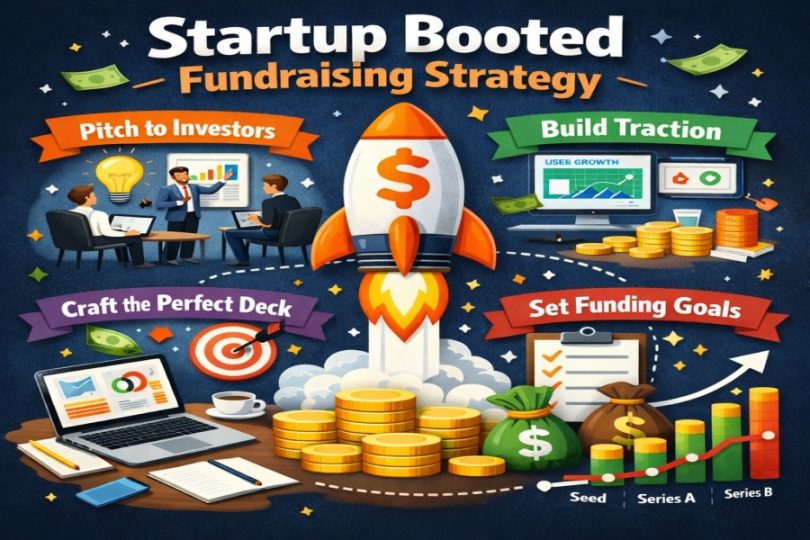

Building a company from scratch is challenging. Building it with limited resources while protecting ownership and long-term vision is even harder. That is where a Startup Booted Fundraising Strategy becomes essential. In today’s competitive ecosystem, founders are no longer rushing blindly toward venture capital. Instead, many are choosing disciplined growth, smart capital planning, and staged fundraising to reduce risk and maintain control.
A Startup Booted Fundraising Strategy is not about avoiding funding altogether. It is about earning the right to raise capital from a position of strength. It focuses on revenue-first thinking, operational discipline, lean execution, and selective fundraising at the right time. This strategy allows founders to validate ideas, build traction, and negotiate better terms when they do raise funds.
This article will break down the complete structure of a powerful Startup Booted Fundraising Strategy, including mindset, financial preparation, traction building, fundraising timing, risk management, and long-term sustainability.
Understanding the Core Philosophy
A Startup Booted Fundraising Strategy combines two powerful concepts:
-
Bootstrapping – Growing with minimal external funding.
-
Strategic Fundraising – Raising capital only when necessary and from a position of leverage.
The goal is not to reject investors. The goal is to avoid dependency.
Traditional startup advice often encourages rapid fundraising as a milestone of success. However, early fundraising can lead to:
-
Dilution of ownership
-
Pressure for aggressive scaling
-
Misaligned investor expectations
-
Reduced strategic flexibility
A well-designed Startup Booted Fundraising Strategy reverses that order. It prioritizes:
-
Revenue before valuation
-
Customers before investors
-
Validation before expansion
-
Discipline before growth
Why Founders Are Moving Toward This Strategy
Modern founders are more informed than ever. They have seen companies collapse under excessive funding without product-market fit. They have watched overvaluation create unrealistic expectations. They have experienced investor misalignment.
A Startup Booted Fundraising Strategy offers several advantages:
1. Stronger Negotiation Power
When your startup generates revenue, investors compete for you.
2. Reduced Dilution
Raising funds later often means higher valuation and lower equity loss.
3. Better Decision-Making
Revenue-backed startups make decisions based on customers, not investor pressure.
4. Sustainable Growth
Growth funded by customers is more stable than growth fueled purely by capital.
The Foundational Phases of a Startup Booted Fundraising Strategy
Phase 1: Lean Validation
Before thinking about fundraising, validate:
-
Real problem
-
Paying customers
-
Repeatable demand
-
Clear target market
You must answer one question:
Will someone pay for this?
Validation methods:
-
Pre-sales
-
Landing pages with payment options
-
Pilot programs
-
Direct service models
-
Manual MVP testing
Avoid building complex products before validating demand.
Phase 2: Revenue-First Growth
Revenue creates leverage. Focus on:
-
Early adopters
-
Small contracts
-
Consulting-based hybrid models
-
Subscription pilots
Even small consistent revenue changes your position dramatically.
| Revenue Level | Strategic Advantage |
|---|---|
| $1K/month | Early validation proof |
| $10K/month | Growth viability signal |
| $50K/month | Investor attraction stage |
| $100K+/month | Strong fundraising leverage |
A disciplined Startup Booted Fundraising Strategy aims to reach predictable revenue before raising institutional capital.
Phase 3: Financial Discipline
Capital efficiency is a core pillar.
Key principles:
-
Minimize fixed costs
-
Outsource non-core functions
-
Avoid luxury tools
-
Negotiate everything
-
Hire slowly
Track:
-
Burn rate
-
Runway
-
Customer acquisition cost
-
Lifetime value
-
Contribution margin
Investors respect founders who understand numbers deeply.
When Should You Raise Funds?
A Startup Booted Fundraising Strategy does not mean “never raise money.”
Raise funds when:
-
Demand exceeds operational capacity
-
Scaling requires capital infrastructure
-
Market opportunity is time-sensitive
-
Competitors are accelerating
The key difference: you raise to accelerate proven growth, not to discover it.
Types of Funding Suitable for Booted Startups
1. Revenue-Based Financing
Repayment tied to revenue percentage.
2. Angel Investors
Strategic individuals who understand early traction.
3. Strategic Partnerships
Corporations investing for market alignment.
4. Convertible Notes
Delay valuation discussion until stronger metrics.
5. Government Grants
Non-dilutive capital options.
Choose funding that aligns with your growth pace.
Building Investor Readiness
Before pitching, ensure:
-
12–18 months financial projections
-
Clear customer acquisition channels
-
Documented traction metrics
-
Defined scaling plan
-
Risk mitigation strategy
Your pitch must communicate control, not desperation.
Traction Metrics That Matter
Investors evaluate risk. Reduce it with numbers.
Important metrics:
-
Monthly recurring revenue
-
Growth rate
-
Retention rate
-
Churn percentage
-
Gross margin
-
Unit economics
A strong Startup Booted Fundraising Strategy ensures these numbers are solid before investor conversations begin.
Maintaining Ownership and Control
One major benefit of a Startup Booted Fundraising Strategy is ownership preservation.
Founders should:
-
Avoid unnecessary early dilution
-
Negotiate board structure carefully
-
Understand liquidation preferences
-
Clarify voting rights
-
Avoid aggressive anti-dilution clauses
Raising capital is not just about money. It is about long-term power dynamics.
Risk Management Framework
Booted founders must manage risk carefully.
Operational Risk
Mitigate through diversified revenue streams.
Financial Risk
Maintain 6–9 months runway minimum.
Market Risk
Constantly gather customer feedback.
Competitive Risk
Focus on differentiation and brand positioning.
Scaling After Strategic Fundraising
Once capital is raised under your Startup Booted Fundraising Strategy, scaling should be controlled.
Focus on:
-
Expanding profitable channels
-
Strengthening team leadership
-
Investing in product stability
-
Automating core processes
-
Improving customer experience
Avoid scaling everything at once.
Psychological Discipline of Founders
Bootstrapped founders must develop resilience.
Common challenges:
-
Slower growth
-
Cash flow stress
-
Limited team size
-
Market comparison pressure
Success requires:
-
Long-term thinking
-
Patience
-
Strategic decision-making
-
Emotional control
A mature Startup Booted Fundraising Strategy is as much psychological as financial.
Common Mistakes to Avoid
-
Raising too early
-
Ignoring unit economics
-
Hiring before revenue consistency
-
Overestimating market demand
-
Building complex tech too soon
-
Accepting unfavorable investor terms
-
Failing to track cash flow
Avoiding these mistakes increases survival probability dramatically.
Designing Your Custom Startup Booted Fundraising Strategy
Every startup is different. Consider:
-
Industry capital intensity
-
Competitive landscape
-
Founder experience
-
Market timing
-
Revenue predictability
Sample Strategic Timeline
| Stage | Focus | Capital Approach |
|---|---|---|
| Idea Stage | Validation | Personal savings |
| Early Revenue | Traction | Minimal angel capital |
| Growth Stage | Expansion | Strategic fundraising |
| Scale Stage | Market capture | Institutional investment |
Long-Term Sustainability
The ultimate goal of a Startup Booted Fundraising Strategy is sustainability.
A sustainable startup:
-
Controls burn rate
-
Generates predictable revenue
-
Maintains healthy margins
-
Keeps ownership balanced
-
Aligns investor expectations
Sustainability builds generational companies, not temporary hype.
How This Strategy Improves Founder Freedom
Freedom includes:
-
Decision-making autonomy
-
Product direction control
-
Culture preservation
-
Strategic flexibility
When you adopt a structured Startup Booted Fundraising Strategy, you reduce external pressure and protect your vision.
Future Outlook
The startup ecosystem is evolving. Investors are becoming more cautious. Profitability and capital efficiency are returning to center stage.
Startups built with a disciplined Startup Booted Fundraising Strategy will outperform those dependent on continuous funding rounds.
The future favors founders who:
-
Build revenue early
-
Control expenses
-
Raise strategically
-
Scale responsibly
Frequently Asked Questions (FAQ)
What is a Startup Booted Fundraising Strategy?
It is a growth approach where startups bootstrap initially, build traction, and raise funds strategically after validation.
Is bootstrapping better than venture capital?
It depends on industry and goals. Bootstrapping offers control. Venture capital offers speed. Strategy matters more than ideology.
When is the right time to raise funds?
When your product-market fit is validated and capital will accelerate proven growth rather than fund experimentation.
Can tech startups follow this strategy?
Yes, especially SaaS, marketplaces, and service-enabled platforms. Capital-intensive hardware may require hybrid models.
How much revenue should I generate before fundraising?
There is no fixed number, but predictable recurring revenue significantly strengthens your position.
Does this strategy slow growth?
Initially, yes. However, it often leads to healthier and more sustainable long-term growth.
What are the biggest risks?
Cash flow mismanagement, underestimating costs, and delaying fundraising too long can create pressure.
Final Thoughts
A Startup Booted Fundraising Strategy is not about avoiding ambition. It is about building intelligently. It is about validating before scaling, earning before raising, and negotiating from strength rather than necessity.
In a world where funding headlines often dominate startup conversations, disciplined founders are quietly building resilient companies through structured capital planning. By combining lean execution, financial awareness, traction building, and strategic fundraising, you create not only a scalable business but also a stable foundation.
The most successful startups of the next decade may not be the fastest funded. They will be the most disciplined, the most capital-efficient, and the most strategically funded.