
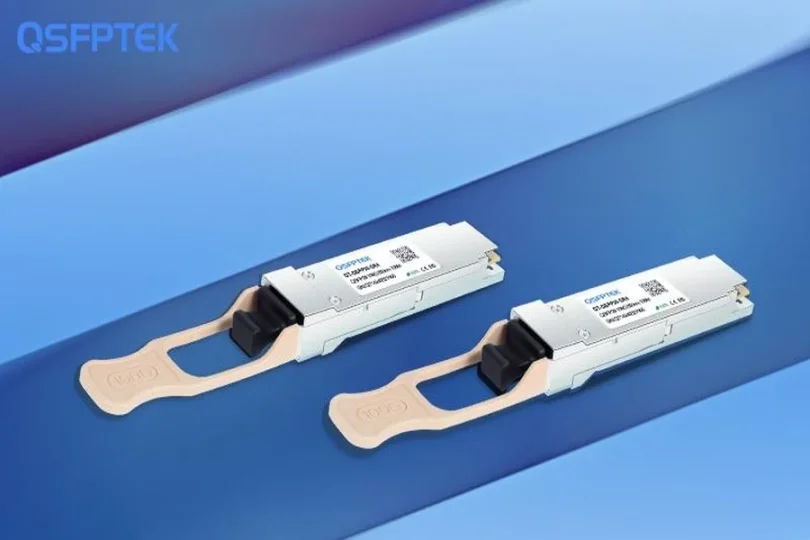

While cutting-edge applications drive the adoption of 400G and 800G technologies, 100G Ethernet remains the workhorse speed for server access and intra-fabric connectivity in modern data centers. For the essential task of connecting equipment within and between adjacent racks, a solution that balances high bandwidth, port density, and cost is paramount. This is where the 100G SR4 QSFP28 optical transceiver excels. As a mainstay for short-reach multimode fiber (MMF) connections, it provides a reliable and economical path to 100G, forming the dense connective tissue of high-performance networks. This article explores the 100GBASE-SR4 standard, its operation, and why it continues to be a critical component in network infrastructure.
What is SR4?
SR4 stands for Short Reach 4-lane. It is a 100G optical interface standard defined primarily by the IEEE 802.3bm specification. The core principle of SR4 is parallel optics: it transmits and receives data over four independent optical lanes in each direction. Each lane operates at 25 Gbps using NRZ (Non-Return-to-Zero) modulation, aggregating to a total bandwidth of 100 Gbps.
Key Characteristics
- Data Rate: 100 Gbps aggregate (4 x 25 Gbps lanes).
- Reach: Up to 100 meters over OM4 multimode fiber, or 70 meters over OM3 fiber. For very short reaches (~3m), it can also use a low-cost MPO ribbon cable.
- Fiber Type: Uses multimode fiber (MMF), specifically OM3 or OM4 grades.
- Connector: MPO/MTP-12 connector. This single connector houses 12 fibers: 4 for transmit, 4 for receive, with 4 unused (or sometimes used for alignment).
- Wavelength: All eight lanes (4 Tx, 4 Rx) operate at the 850nm wavelength window.
- Application: Designed specifically for high-density, short-reach connections within a data center, such as between top-of-rack (ToR) switches and spine switches, or between adjacent racks.
100G-SR4 QSFP28 Overview
The QSFP28 is the standard form factor for 100G pluggable modules, and the 100G SR4 QSFP28 is its most common implementation for MMF environments.
Working Principle
The module’s operation is elegantly straightforward:
- The host switch sends four electrical lanes of 25 Gbps data to the transceiver.
- Inside the module, laser drivers modulate four 850nm VCSEL (Vertical-Cavity Surface-Emitting Laser) arrays, converting each electrical lane into an optical signal.
- These four optical signals are coupled into four parallel fibers within the transmit side of the MPO connector.
- On the receive path, four photodiodes detect the incoming optical signals from the other four fibers in the MPO connector and convert them back into four lanes of electrical data.
- An integrated Digital Diagnostic Monitoring (DDM/DOM) chip provides real-time monitoring of temperature, voltage, TX/RX optical power, and laser bias current.
Key Features
- QSFP28 Form Factor: The compact, hot-pluggable design allows for high port density (up to 36 ports in a single 1U front panel), which is crucial for scalable data center design.
- MPO Connector Interface: The MPO-12 connector enables a single plug to establish all 8 optical connections (4 Tx, 4 Rx), simplifying cabling compared to managing 8 individual LC connections.
- VCSEL-based Technology: The use of 850nm VCSELs is a key cost advantage. VCSELs are less expensive to manufacture than the single-mode lasers used in LR4 or CWDM4 modules, making SR4 the most cost-effective 100G solution for short reaches.
- Compliance and Interoperability: Complies with IEEE 802.3bm, CE, and RoHS standards, ensuring multi-vendor interoperability and reliable performance.
- Low Power Consumption: Typically consumes between 2.5W to 3.5W, contributing to better power usage effectiveness (PUE) in large-scale deployments.
Main Applications
The 100G QSFP28 SR4 transceiver is the backbone of short-reach, high-speed connectivity in several key scenarios:
- Data Center Spine-Leaf Architecture: It is the standard choice for 100G links connecting leaf (ToR) switches to spine switches within the same or adjacent rows.
- High-Performance Computing (HPC) Clusters: Provides the low-latency, high-bandwidth interconnects required between computing and storage nodes in cluster networks.
- Enterprise Core Networks: Used to interconnect core switches in large enterprise data centers or campus backbones where distance is limited.
- Cloud Infrastructure: Widely deployed in hyperscale cloud data centers for its density, reliability, and total cost of ownership.
Key Advantages
Choosing 100G SR4 QSFP28 offers several compelling benefits:
- Highest Cost-Efficiency: It is the lowest-cost 100G optical solution available, thanks to its use of VCSEL technology and MMF.
- Maximum Port Density: The QSFP28 form factor combined with simple MPO cabling allows network operators to maximize bandwidth per rack unit.
- Cabling Simplicity: A single MPO trunk cable replaces eight duplex LC patch cords, reducing cable clutter, simplifying installation, and improving airflow in racks.
- Proven Reliability: As a mature technology with years of widespread deployment, SR4 offers exceptional operational stability and reliability.
- Clear Migration Path: It provides a natural and economical upgrade path from 40G SR4 (using QSFP+) to 100G within the same MMF infrastructure.
Conclusion
In the ecosystem of 100G optics, the 100GBASE-SR4 QSFP28 transceiver holds a distinct and vital position. It is the undisputed champion for cost-optimized, high-density connectivity over distances of 100 meters or less. By leveraging parallel optics over multimode fiber with the compact QSFP28 form factor, it delivers the essential bandwidth required for modern data center fabrics without unnecessary complexity or expense. As networks continue to evolve, SR4 remains a foundational technology, proving that for short-reach applications, simplicity, density, and affordability are the most powerful features of all. Learn more from Voomixi Com.